
Last week, I had the honor of facilitating a working meeting for the Veteran Wellness Alliance (VWA), where a number of the space’s most effective organizations came together to figure out how we can all do better. And early in the conversation, somebody asked me about the “noise”, the clutter of information and adoptions that Veterans and their families must sift through in order to find the communities and care that they really need. That question got me thinking, and before I knew it, I was sketching something out on the whiteboard, because while there are certainly some bad actors in the Veteran landscape, the largest impediment to finding truly beneficial programs is the sheer volume of not-so-great options.
You’re likely familiar with the Pareto Principle (the old 80/20 rule), which tells us that roughly 80% of our results come from roughly 20% of our efforts. Once you see it, you can’t unsee it. It shows up everywhere, and it has for a long time.
As much as I love the concept, I think we might reconsider it (at least in this context) because the way that we distribute our time, attention, and energy is actually less of a power law distribution, and more like a bell curve. I believe this is because we live in an incredibly noisy world, having to deal with a seemingly endless flow of inputs and activities – making it very difficult to identify the truly critical aspects of our life and work, and nearly impossible to remain disciplined to them. In some ways, it has always been difficult to identify and stay focused on the core drivers of health, happiness, and performance. That's not new. What is new is the ridiculous amount of sophisticated, well-packaged alternatives competing for our attention.
Enter the Harm-Hype-Help curve. Imagine all of the content you consume and activities that make up your day, plotted on a bell curve. On the left tail, you have things that are genuinely harmful, bad information, habits, or behaviors that actively work against you. On the right tail, you have things that are truly helpful, the small number of inputs, practices, and priorities that actually drive the results looking for. And in the wide, bloated middle, we have hype. Not harmful, exactly. But not helpful either. Just...noise.
And here’s my guess: It’s the hype that’s holding us back.
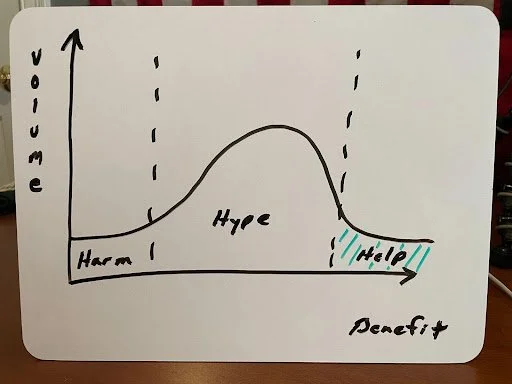
Author’s illustration
When progress is slow or things aren’t going well, it is easy to look for an obvious culprit. We’re quick to identify anything from a toxic employee to seed oils for ruining our plans! But it is rarely something acute or poisonous that’s killing our results. This Harm-Hype-Help curve reveals the uncomfortable truth that most of what we consume, do, and invest in as individuals and organizations does little more than maintain the status quo.
Take something as personal as health and fitness. If you went looking for good information on diet, exercise, or recovery right now, you wouldn't struggle to find it. You'd drown in it. The internet is full of podcasts, influencers, supplement brands, and training programs, each with compelling testimonials and a persuasive case for why this is the thing that will change everything.
And here's what makes this particularly tricky: most of it isn't wrong. It's just not that right, either. It's general where it needs to be specific. It's flashy where it needs to be boring. It allows us to feel like we’re making progress while mostly ignoring the stuff that really moves the needle. It’s not necessarily harmful, but it's also not helpful. For a moment, it is hopeful, but ultimately, it’s just hype.
This dynamic doesn't stay personal. It follows us to work.
AI and technology have not created this problem. But they have accelerated it dramatically. When access to information, analysis, and production becomes frictionless, the volume of everything increases, including the hype. This holds true for communication. We can text, email, Slack, Teams, and Zoom with the push of a button, convincing ourselves that we are connected and productive, but are we really?
In large organizations especially, it is remarkably easy to fill a calendar, an inbox, or a slide deck, and generate the appearance of momentum without meaningfully advancing anything. Meetings about meetings. Metrics that measure activity rather than outcomes. Nothing bad, necessarily. But collectively, it is the organizational equivalent of hype – high volume, low benefit. All flash, no bang.
“People will go for anything they don’t understand if it’s got enough hype.”
The leaders I respect most have developed a ruthless clarity about where the curve crosses over into Help. They've learned to ask hard questions early in the process. They address an interpersonal conflict before it goes sideways. They cut the crap with difficult customers or vendors. And most impressively, they execute with discipline, caring very little about what looks good because they are too busy doing what IS good.
The challenge isn't usually ignorance. Most people, if pressed, could tell you what should be focused on. The challenge is discipline. It's the willingness to resist the pull of the interesting in favor of the important, to avoid the empty promises of efficiency and simply do the work.
So much of what we're sold, what we scroll through, and what fills our organizations' calendars lives in that wide, comfortable middle. And this stuff won’t kill us quickly, but it’ll kill us just the same. Wendell Berry might call this part of the “slow forgetting”, a gradual detachment from what really matters.
Back at the VWA, we spent a day and a half focused not on creating something new and innovative, but on leveraging the amazing resources that were already in the room! We had wonderful conversations about removing friction, creating clarity, and improving communication, all so that those we serve can more readily find their way to the communities and care that actually HELP.
You can do the same, just beware of the hype.