
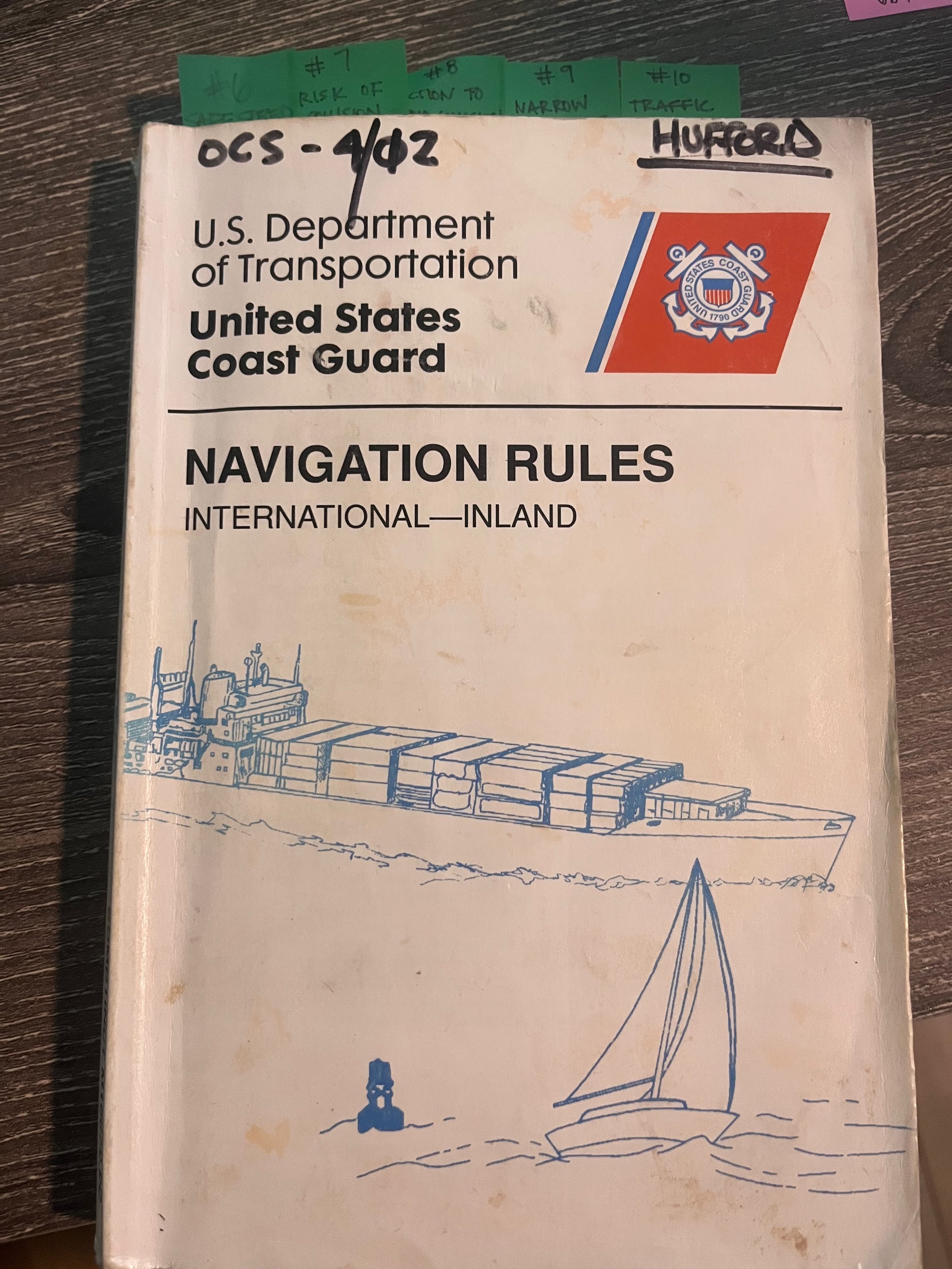
The most highlighted, coffee-stained, tabbed, marked-up book I’ve ever owned is the Coast Guard’s Navigation Rules, also known as the Rules of the Road. It’s nostalgic to flip through the pages and see my handwritten notes from nearly 25 years ago. If you’ve never seen one, think of it as the Driver’s Ed manual for boats and the water. Before I could become a Deck Watch Officer in the Coast Guard, I had to pass the Rules of the Road test with at least a 90%. And that was just the entry fee. After that, I was assigned to a ship and spent roughly a year working toward the qualification, where the rules become even more complicated during operations. A good part of my brain still has much of this book memorized, and I’m sure it always will. And I’ve realized it’s become a symbol of so many aspects of life and work.
There are about 41 rules for international waters and about 38 for inland rivers, lakes, and harbors. They cover who gives way to whom, what a certain number of blasts from the horn means in a certain situation, and how to identify a vessel at night by nothing more than a pattern of lights to tell you what it is, which way it’s headed, and whether it’s about to become your problem.
Some of the most important rules are about communication. The horn is a language. Certain patterns of blasts mean “I intend to do this,” and others say, “I don’t understand what you’re doing.” When two vessels are closing in on each other, you need to be clear, you need to be early, and you need to say what you’re about to do before you do it. I’ve been in plenty of hard conversations on dry land where that same standard would have saved everyone a lot of grief.
At night, the lights tell you how to read a situation when you can’t see all of it. Depending on the lights you see, you need to discern what you’re looking at, how big it is, and which way it’s moving. Anyone who has led a team through a crisis with partial information and a running clock knows that feeling.
Then there’s the heart of the whole book: who gives way and who stands on. The rules are simple to state, but require discipline to execute. Two situations show it best: a crossing situation and an overtaking situation.
A crossing situation involves two vessels whose paths will meet. The vessel with the other on her starboard (right) side must keep out of the way. The other vessel holds her course and speed. It sounds simple until you’re the one holding course, trusting the other vessel to follow the rules while staying ready in case they don’t.
An overtaking situation works the opposite way from what most people expect. The faster ship, the one coming up from behind, has to keep out of the way of the one she’s passing. And maintains that responsibility until she’s completely past and clear. Being faster doesn’t earn you the right of way. It makes you responsible for how you go around someone else. At ALPs, we’ve seen the same principle play out in teams, where the person moving quickly assumes everyone else will adjust and then gets frustrated when they don’t.
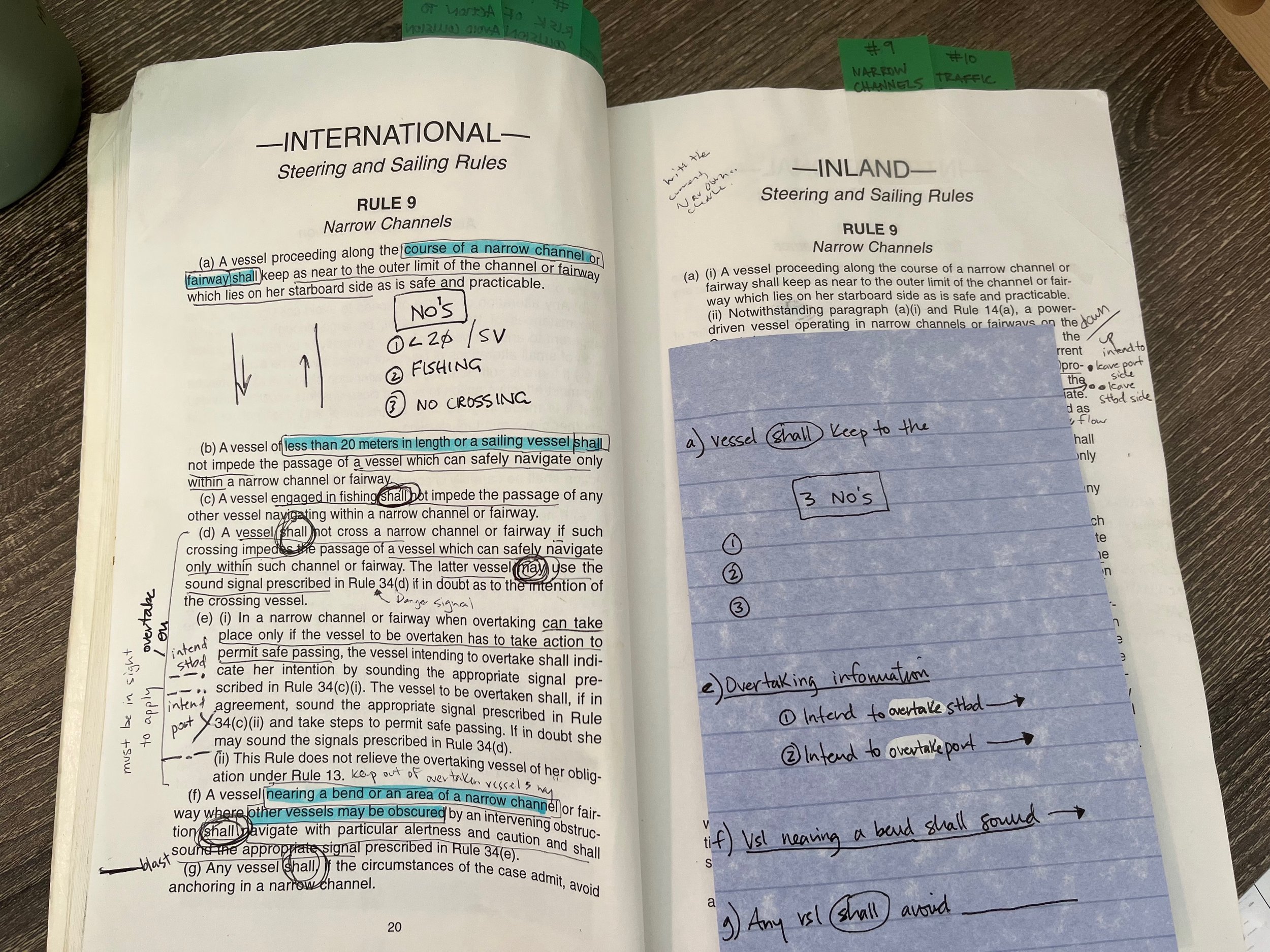
It wasn’t until I was on the navigation bridge, fully responsible for the ship's safe voyage, with a sweat-inducing situation unfolding in front of me, that I fully grasped the rules. That I could figure out what it meant for this ship, in this water, right now. The book gave the rules. The bridge taught how to use it. The knowledge came through the doing.
While I memorized so many of these rules for quick decision-making and professional knowledge, my Rules of the Road book is worn for a good reason. Sometimes I needed to act quickly on instinct. But much of the time, like life, standing watch was an open-book test. I carried my copy with me to the navigation bridge for every watch. There was always at least one copy on the bridge that was never to be removed. No one thought of it as a weakness to reach for it. It was part of everyone's job while standing watch. Checking the rules didn't mean you were unprepared. It meant you took the stakes seriously enough to be sure. And the Captain commanded us to call him for help if we were in doubt.
We pick up knowledge in classrooms, trainings, books, podcasts and well-meaning advice. We highlight it, tab it, and nod along. Then something real happens and we find out what we actually do know. How often do we treat rereading the SOP, pausing to check our bearings, or getting a gut-check from a colleague as a sign of failure? We hold ourselves to the standard of having it all figured out, when the best sailors I worked for and with knew the rules cold, but they weren’t too proud to look something up.
This book brings back so many memories. It earned every worn page on the bridge in action, not gathering dust on a desk. Learn the rules. Then get on the bridge and make some decisions. And keep the book within reach.
